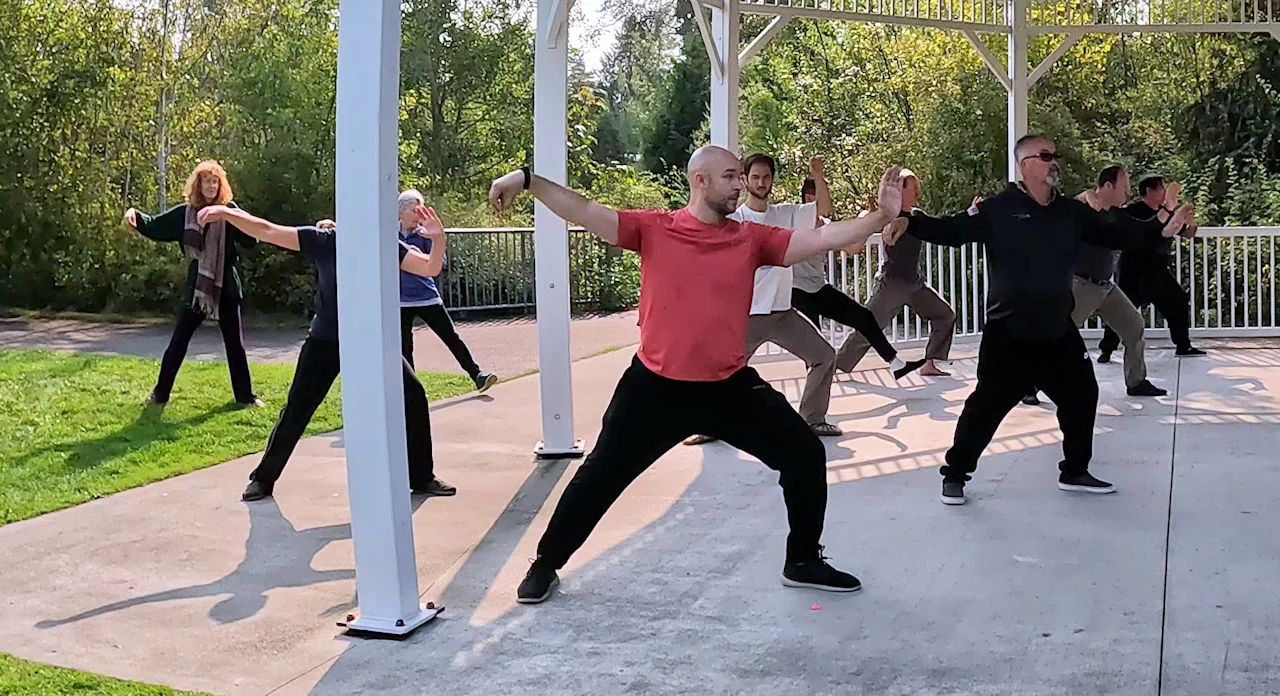
Slow movement. Steady attention. A traditional practice you can keep learning for life.
A martial tradition. A mindful way to move.
Tai Chi, also called Tai Chi Chuan, is a Chinese martial art practiced through connected movements, balance, and coordination.
Instead of rushing from one position to the next, you learn to pay attention to posture, weight shifts, and how movements connect. Red Dragon’s program is described as Yang Style Tai Chi, known for its flowing sequences.
Students come to the practice for different reasons: to stay active, explore a martial tradition, make time for calm, or work on body awareness. You can begin without previous experience.
WHY PEOPLE PRACTICE
Small movements. Meaningful attention.
01
Move with intention.
Practice steady weight shifts, coordinated movements, and awareness of how your body moves. Paying attention to how you stand, step, and turn gives each movement a clear purpose. The goal is to understand the connection between positions, rather than simply copy their shape.
02
Make space for calm.
Give your attention to slow movement and a comfortable rhythm, away from the rush of the day. Tai Chi offers a task to focus on in the present moment: following a movement, noticing your posture, and connecting one action to the next.
03
Build a lasting practice.
Learn something you can return to over time, at a pace that respects your starting point. Familiar movements can become the foundation for deeper study. A consistent, manageable routine gives you room to learn without turning every session into a test of performance.
People often practice Tai Chi to support balance, mobility, coordination, and relaxation. Individual experiences vary.
Where can I learn Tai Chi near Buffalo?
Red Dragon School of Martial Arts serves Buffalo and Western New York from Blasdell. Its current focus is Tai Chi instruction with Sifu Robert A. Gott.
Yang Style is one of the established traditions of Tai Chi Chuan. Red Dragon’s program is described as Yang Style Tai Chi, and Robert’s training includes study with Yang family masters. For a prospective student, the important distinction is that Tai Chi is a connected practice with a training tradition, rather than a collection of unrelated exercise movements.
A form is a sequence of movements practiced in an established order. Learning the sequence provides a framework for studying posture, transitions, and coordination. Different forms and class levels may be taught, so ask Robert about the material currently offered instead of assuming that every Yang Style class uses the same sequence.
Why do people choose Tai Chi?
People arrive with different goals. Some want a slower-paced way to stay active. Others enjoy learning the details of a traditional martial art or having a regular activity that calls for focused attention. The same movement can give a beginner a first lesson in coordination and give an experienced student something to refine.
Slower movement does not mean that learning is effortless. Following a sequence, making controlled transitions, and remembering what comes next all take practice. You can approach that process patiently, without treating the class as a competition.
Is Tai Chi only for older adults?
No. Tai Chi is practiced by adults across many ages. Older beginners may appreciate its deliberate pace, while younger adults may be drawn to the tradition, attention to detail, or contrast with a busy daily routine. Your starting point and reasons for learning do not need to match another student’s.
How does Tai Chi connect movement and attention?
A movement is more than the final position of the hands. You also pay attention to how your weight shifts, where your feet are placed, and how the transition connects to the next action. That gives you something concrete to concentrate on, even while repeating familiar material.